Diesel Generator Fuel Consumption - Litres Per Hour by kVA (Full Chart)
The short answer
A diesel generator burns roughly 0.24 to 0.30 litres of fuel per kilowatt-hour of electricity it produces. Bigger sets sit at the efficient end of that range, small sets at the thirsty end, and every set gets less efficient the further it runs below its rating.
For a quick estimate, take the generator's kVA rating, multiply by 0.8 to get kW, multiply by your load percentage, then multiply by 0.26.
A 500 kVA set running at 75% load: 500 × 0.8 × 0.75 × 0.26 = about 78 litres per hour.
The full chart below does that calculation for every common size we supply, from 10 kVA up to 3000 kVA.
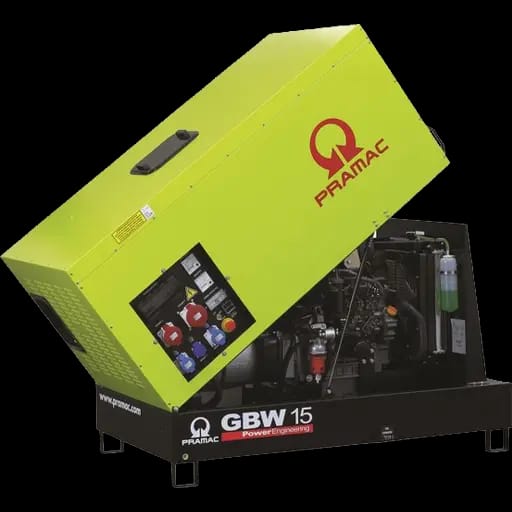
Full fuel consumption chart: litres per hour by kVA
These figures are calculated at 0.8 power factor, which is the standard rating basis for three-phase generator sets. They include a part-load efficiency penalty, because a generator running at half load does not use half the fuel of one at full load.
| Generator Size | Output (kW) | 50% Load | 75% Load | 100% Load |
|---|---|---|---|---|
| 10 kVA | 8 kW | 1.3 L/hr | 1.8 L/hr | 2.3 L/hr |
| 20 kVA | 16 kW | 2.7 L/hr | 3.7 L/hr | 4.6 L/hr |
| 30 kVA | 24 kW | 4.0 L/hr | 5.5 L/hr | 7.0 L/hr |
| 50 kVA | 40 kW | 6.7 L/hr | 9.1 L/hr | 11.6 L/hr |
| 60 kVA | 48 kW | 7.5 L/hr | 10.2 L/hr | 13.0 L/hr |
| 100 kVA | 80 kW | 12.4 L/hr | 17.0 L/hr | 21.6 L/hr |
| 150 kVA | 120 kW | 18.6 L/hr | 25.5 L/hr | 32.4 L/hr |
| 200 kVA | 160 kW | 23.0 L/hr | 31.5 L/hr | 40.0 L/hr |
| 250 kVA | 200 kW | 28.8 L/hr | 39.4 L/hr | 50.0 L/hr |
| 300 kVA | 240 kW | 34.5 L/hr | 47.3 L/hr | 60.0 L/hr |
| 400 kVA | 320 kW | 46.0 L/hr | 63.0 L/hr | 80.0 L/hr |
| 500 kVA | 400 kW | 57.5 L/hr | 78.8 L/hr | 100.0 L/hr |
| 600 kVA | 480 kW | 66 L/hr | 91 L/hr | 115 L/hr |
| 800 kVA | 640 kW | 88 L/hr | 121 L/hr | 154 L/hr |
| 1000 kVA | 800 kW | 110 L/hr | 151 L/hr | 192 L/hr |
| 1250 kVA | 1000 kW | 135 L/hr | 185 L/hr | 235 L/hr |
| 1500 kVA | 1200 kW | 162 L/hr | 222 L/hr | 282 L/hr |
| 2000 kVA | 1600 kW | 216 L/hr | 296 L/hr | 376 L/hr |
| 2500 kVA | 2000 kW | 270 L/hr | 370 L/hr | 470 L/hr |
| 3000 kVA | 2400 kW | 324 L/hr | 444 L/hr | 564 L/hr |
Note: Fuel consumption figures are estimates and can vary depending on the generator model, engine efficiency, operating conditions, ambient temperature and actual load.
Be clear about what this chart is. These are engineering estimates for planning, tank sizing and budgeting. They are not manufacturer datasheet figures. Two 500 kVA sets from different manufacturers, or with different engines, can differ by 5 to 10% at the same load. Before you commit to a fuel contract or a bulk tank size, get the actual consumption curve from the datasheet for the specific model. We publish or supply these on request for every set we stock.
How the numbers were worked out
We would rather show the method than ask you to trust a table.
Diesel contains roughly 9.9 kWh of usable energy per litre. A generator set converts a fraction of that into electricity. That fraction is the overall efficiency, and it drives everything:
- Small sets (10 to 50 kVA): around 33% efficient at full load, so about 0.29 litres per kWh
- Mid-range (60 to 150 kVA): around 36%, so about 0.27 litres per kWh
- Large (200 to 500 kVA): around 39%, so about 0.25 litres per kWh
- Very large (600 kVA and above): 40 to 42%, so about 0.235 to 0.24 litres per kWh
We then applied a part-load penalty: roughly 5% worse specific consumption at 75% load, and roughly 15% worse at 50% load, because a diesel engine is least efficient when it is lightly loaded.
If you want to run your own numbers:
Litres per hour = kVA × 0.8 × load factor × specific consumption
Working out what it actually costs you
Fuel is almost always the largest line in a generator's operating cost, so this is the calculation that matters.
Cost per hour = litres per hour × price per litre
A 250 kVA set at 75% load uses 39.4 litres per hour. At £1.20 per litre that is £47.28 per hour, or £1,134 for a 24-hour outage. Substitute your own delivered bulk price, which will vary with volume, region and whether you are entitled to rebated fuel.
Two things people routinely forget when budgeting:
- Monthly testing adds up. A standby set tested for one hour a month at 30% load is a small number. A set tested under proper load for four hours a quarter is a real cost, and one you should plan for rather than discover.
- Prime power is a different world. A set running 8 hours a day, 250 days a year at 75% load is burning fuel for 2,000 hours. For a 500 kVA set that is roughly 157,000 litres annually. At that scale a 5% efficiency difference between two machines is worth more than the price gap between them.
How long will the base tank last?
Most canopied generator sets are supplied with a base fuel tank sized to give around 8 hours at 75% load. That is a design convention, not a law, and it varies by manufacturer and range.
To work out your own runtime:
Runtime in hours = usable tank litres ÷ litres per hour at your load
Usable is not the same as nominal. Leave a margin at the bottom of the tank so you never draw sediment or air into the fuel system. Plan on around 90% of the stated capacity.
If you need to ride out a multi-day outage, the base tank is not enough on its own. You will need a bulk tank with a transfer system, or a fuel delivery contract with a guaranteed response time. For anything above about 200 kVA running for more than a day, arrange the fuel supply before you need it, not during the outage.
What actually changes your consumption
The chart assumes a healthy engine on good fuel in normal conditions. Real sites vary.
Load factor is the big one. Running a generator at 30% load does not cost you 30% of the fuel. It costs closer to 40%, and it damages the engine. See the next section.
Ambient temperature and altitude. Hot air is less dense, so the engine breathes less oxygen and the set derates. Above roughly 1,000 metres or 40°C you should expect both reduced output and worse specific consumption. This matters for export projects far more than for UK installations.
Fuel quality and age. Diesel degrades. Water ingress and microbial contamination, known in the trade as diesel bug, clog filters and disturb combustion. Fuel that has sat in a standby tank for two years is not the fuel the engine was designed around. Fuel polishing and a proper sampling regime protect both efficiency and reliability.
Engine condition. Worn injectors, a clogged air filter and a tired turbo all show up as higher consumption before they show up as a breakdown. Rising fuel use at constant load is one of the earliest warnings you get.
Power factor. The chart uses 0.8. If your site load has a materially different power factor, your kW output for a given kVA changes and so does the fuel.
The 30% rule: why running light costs you twice
Diesel engines are designed to run under load. Below about 30% of rated output, combustion temperatures drop far enough that unburnt fuel and soot start passing into the exhaust system. This is called wet stacking, and it leaves oily deposits in the turbo, exhaust and silencer.
Wet stacking costs you twice. You get worse fuel economy in the moment, and you get deposits that reduce performance and eventually require the exhaust side to be stripped and cleaned.
Two practical consequences:
- Do not oversize by habit. A 1000 kVA set installed on a site with a 250 kVA real load will run permanently in the wet stacking zone. It costs more to buy, more to run per unit of output, and will need more attention. Size on measured load with sensible headroom, not on a guess plus a safety factor.
- Do not test at no load. A monthly off-load run does not prove the set will carry the building, and it actively encourages wet stacking. Test under real load, or use a load bank. Annual load bank testing at 75 to 100% is the standard way to burn off deposits and confirm the set will actually perform.
What about HVO?
Hydrotreated vegetable oil is increasingly used as a drop-in replacement for diesel in generator sets, and it is now explicitly recognised in the UK permitting regime. When the Environment Agency amended its standard rules permits for medium combustion plant and specified generators, it added hydrogen and gas oil substitutes including HVO to the relevant permits.
For fuel planning, the number you need is this: HVO holds roughly 4 to 5% less energy per litre than fossil diesel. Same job, slightly more litres. Take the figures in the chart above and add about 5%.
Two things to confirm before switching: that your engine manufacturer approves HVO for your specific model without voiding warranty, and that your existing tank and fuel system are clean. HVO has a mild solvent effect and will lift years of accumulated deposits off tank walls straight into your filters.
If your set is over about 500 kVA, fuel is not your only concern
Fuel consumption and emissions permitting are linked, because both are driven by thermal input. Once a generator's rated thermal input reaches 1 MWth, UK environmental permitting rules start to apply. As a rough guide, that threshold arrives somewhere around 400 to 500 kVA of electrical output, depending on engine efficiency.
Thermal input is not something you should estimate. Ask the manufacturer for the figure, or calculate it using the AMPS method for determining thermal input, which the Environment Agency points operators towards.
If you are running a genuine emergency backup set, note that the testing exclusion is tied to hours: you must not carry out more than 50 hours of testing a year per backup generator without written agreement from your regulator. That constrains how much load bank testing you can do, which in turn affects how you manage wet stacking. It is a genuine tension and worth planning around rather than discovering.
Getting exact figures for your set
The chart on this page will get your tank sizing and your budget into the right shape. For a tender, a fuel contract or a capacity market submission, you want the manufacturer's figures for the exact model.
Every set we supply comes with a full datasheet including consumption at 25, 50, 75 and 100% load. We publish specifications and prices for our diesel generators openly, and we hold a wide range in physical stock, so you can see the current stock list rather than waiting on a build slot.
If you know your load but not your generator size, or you know your generator size and want to sanity-check a fuel contract, get in touch. We will give you the real numbers for the machine rather than a rule of thumb.


Comments
Post a Comment