How Quiet Is a Silent Generator? Real-World Noise Levels for UK Buyers
A silent generator typically runs at around 65–77 dB(A) measured at 1 metre, or roughly 55–68 dB(A) at 7 metres — compared to 75–85 dB(A) for an open-frame unit at the same distance. But the honest answer is: it depends entirely on how and where you measure it, and that's exactly where most buyers get confused.
How Generator Noise Is Actually Measured
Noise is measured in dB(A), or A-weighted decibels, which reflects how the human ear perceives sound intensity. The decibel scale is logarithmic, not linear — a 10 dB increase represents roughly 10 times the sound intensity and is perceived as about twice as loud. This is why a generator rated at 75 dB(A) isn't "a bit louder" than one rated at 65 dB(A) — it's substantially louder.
The detail that catches most buyers out is the measurement distance. Manufacturers typically quote dB(A) at either 1 metre or 7 metres from the unit, and the same generator can show very different numbers depending on which is used. Always check which distance a rating refers to before comparing two models — a 70 dB(A) rating at 1m is far quieter than a 70 dB(A) rating at 7m.
Open vs Silent Generators: The Real Difference
An open-frame (or "open-skid") generator has no acoustic enclosure, so engine and exhaust noise radiates freely. These typically sit in the 75–85 dB(A) range at 1 metre.
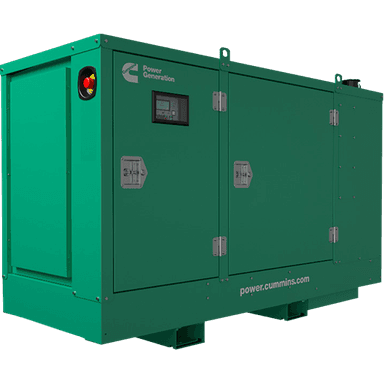
A silent (acoustic canopy) generator wraps the engine, alternator, and exhaust system in sound-deadening material, often combined with internal baffles that trap and absorb sound waves. This typically brings noise down to 65–77 dB(A) at 1 metre — a meaningful reduction, even though "silent" doesn't mean inaudible.
What Actually Affects How Loud It Sounds On
Site
Several factors change the real-world experience beyond the spec sheet number:
● Load level — engines
generally run quieter at partial load than at full rated output.
● Distance and line of sight —
noise drops off rapidly with distance, but hard surfaces (walls, concrete)
reflect sound and can make a generator seem louder than its rating suggests.
● Ground surface — soft ground
absorbs more sound than concrete or tarmac.
● Enclosure quality — not all
"silent" canopies are equal; better insulation, sealed access panels,
and quality mufflers all make a measurable difference.
● Generator size — larger kVA units generally produce more noise than smaller ones, simply because the engine is bigger.
Real-World Noise Comparisons
To put the numbers in context:
● 50–55 dB(A) — similar to
light rainfall or a quiet conversation
● 60–65 dB(A) — similar to a
normal conversation or background office noise
● 70–77 dB(A) — similar to a
vacuum cleaner or busy street traffic
● 80–85 dB(A)+ — similar to a loud hairdryer or heavy machinery
This is why a silent generator at the upper end of its range (around 77 dB(A) at 1m) can still feel genuinely noticeable up close, while the same unit measured at 7 metres might read closer to 65 dB(A) — comfortably in "background noise" territory.
A Note on UK Noise Considerations
If the generator will run near residential properties, offices, or other noise-sensitive sites, it's worth checking local noise guidance before installation — general practice in the UK is that generator noise shouldn't exceed background ambient noise by more than around 10 dB(A) during the day, with stricter limits overnight. This is a separate question from the manufacturer's dB(A) rating, but it directly affects which generator (and which enclosure spec) is the right choice for a particular site.
How to Compare Noise Ratings When Buying
When comparing models, ask for:
1. The dB(A) rating and the distance it was measured at
(1m vs 7m)
2. Whether the figure is at full load, partial load, or idle
3. Whether it's a manufacturer-tested figure or an estimate
A supplier who can give you a clear, distance-specified dB(A) figure from an actual data sheet is giving you something you can genuinely compare — a vague "super quiet" claim with no number isn't.
Final Checklist
Before choosing between open and
silent, or between two "silent" models, confirm: the dB(A) rating and
its measurement distance, the load level it was tested at, your site's noise
sensitivity (residential, commercial, industrial), and any local restrictions
on operating hours or maximum noise. Get these right, and "silent"
stops being a marketing word and starts being a number you can actually plan
around.


Comments
Post a Comment